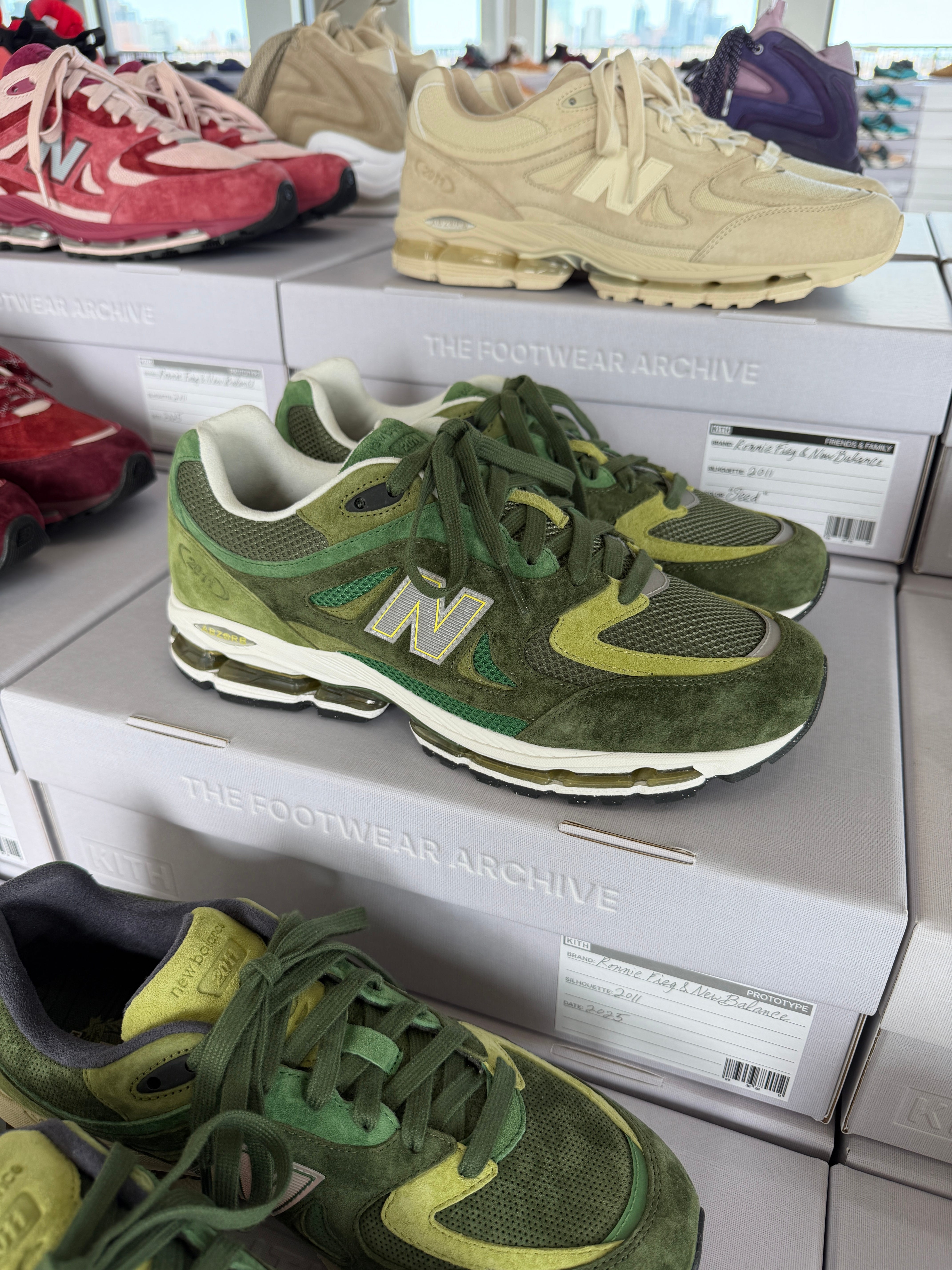
There are 1,849 pairs of shoes on display in Brooklyn, arranged with the order and reverence of artifacts. From a distance, they form a remarkable color study. Up close, they become a history of modern sneaker culture: ASICS runners in saturated suede, New Balance collaborations made in exacting shades, unreleased prototypes, friends and family editions, samples and finished products from almost every major name in footwear.
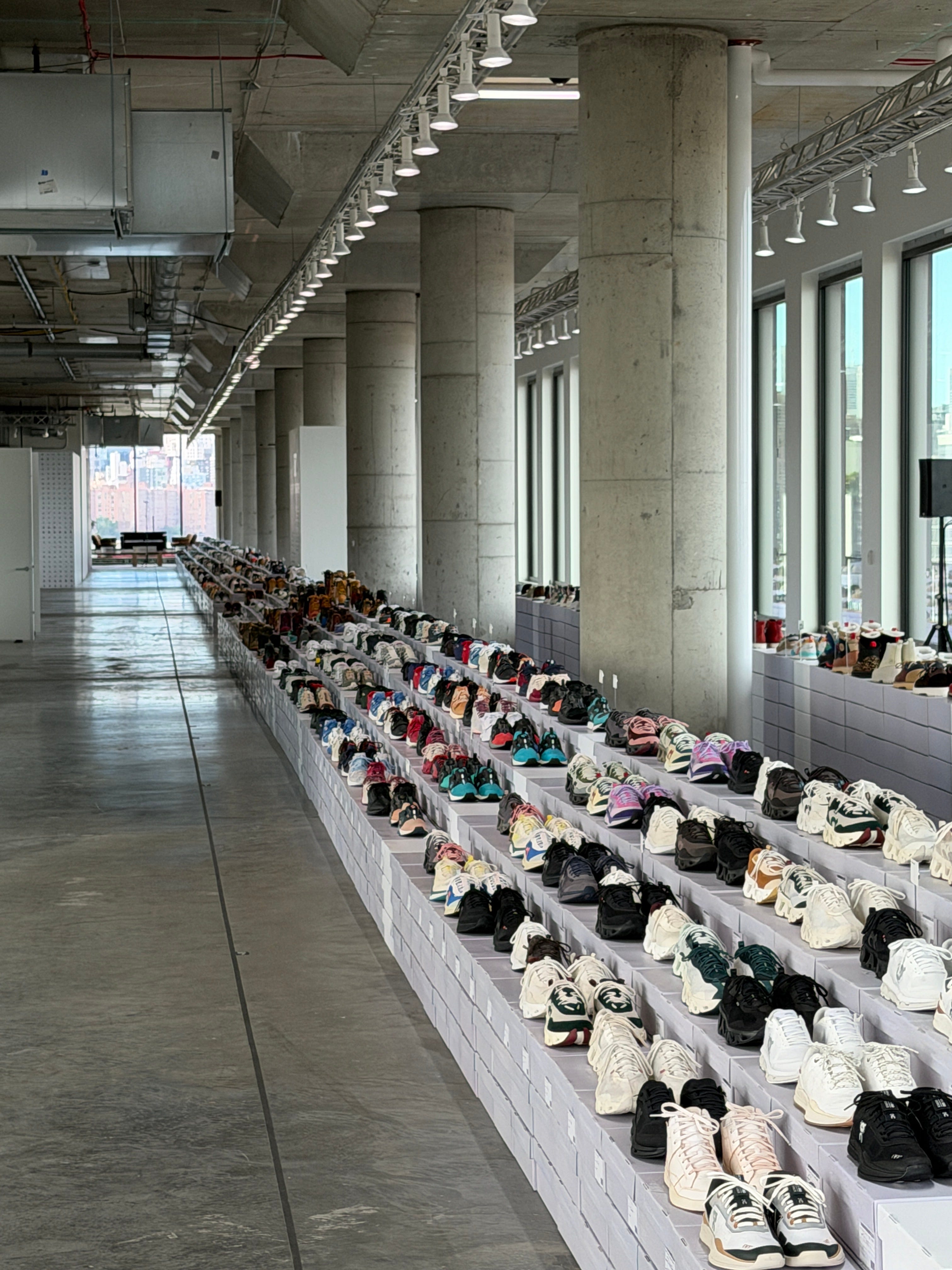
The easiest way to look at them is as evidence of success. They are rare, desirable and, collectively, worth an extraordinary amount of money. They represent fifteen years of Kith, a company that grew from two small spaces in New York into an international retail and lifestyle business. They show what it looks like when a person reaches the top of his field.
But that is not what Ronnie Fieg sees.
For Fieg, the shoes are a calendar. One pair returns him to the birth of his daughter. Another recalls his engagement. Others contain periods when the company was growing, when his personal life was changing, when things were working and when they were not. The archive is not simply a catalogue of product. It is a record of time measured in materials, colors and soles.

This is what makes the exhibition more interesting than a room filled with valuable sneakers. It reveals the part of success that is easiest to overlook once the result appears inevitable: the repetition required to produce it.
Fieg began working at David Z, the New York footwear chain owned by his uncle David Zaken, when he was 13. He started in the stockroom and spent roughly fifteen years learning the business from the floor upward. He learned how customers moved through a store, what they picked up, what they left behind and which small changes could make an overlooked shoe suddenly feel necessary. Long before Kith existed, he was developing a retailer’s eye: less concerned with fashion as an abstract system than with what made a person want to put something on.

His first major breakthrough arrived through ASICS. In 2007, while still at David Z, Fieg worked on a limited release of the Gel Lyte III, a model with little of the cultural force then possessed by Nike, Jordan or Adidas. That disadvantage became an opportunity. The project helped show that a collaborator could create demand not merely by attaching his name to an established object, but by finding value in a silhouette the market had neglected. Color, material, scarcity and context could change the way a shoe was seen.

It was an early lesson in what would become the Kith method: identify an object with dormant emotional value, refine it with obsessive specificity and return it to the public with a story strong enough to alter its position in culture.
Sam Ben Avraham saw the potential in Fieg. Ben Avraham, the founder of Atrium and later the influential trade shows Project and Liberty Fairs, had built his career by understanding how brands, buyers and stores moved together. In 2011, he partnered with Fieg to launch Kith. The first locations were modest and physically connected to Atrium’s stores in Brooklyn and Manhattan. Kith did not arrive looking like an empire. It occupied a small amount of space and depended on the credibility Fieg had accumulated one release and one relationship at a time.

Founders are often described as visionaries after their vision has become visible to everybody else. The more consequential act belongs to the person who sees it earlier. If you had met Fieg before Kith, you might have encountered a relentless footwear buyer with unusual taste and a growing following. Ben Avraham saw the seed of a much larger business.
Kith opened as a footwear destination, but one of its first important proprietary products was not a shoe. It was the Mercer pant, a pair of cotton twill pants cut with a ribbed cuff above the ankle. The idea now appears almost self evident. At the time, it answered an immediate problem for sneaker collectors: ordinary pants covered the product they cared about most. The Mercer allowed the entire shoe to remain visible.
That small adjustment contains much of Fieg’s business philosophy. The pant did not ask the customer to adopt a new identity. It paid close attention to the identity he already had. Kith understood that sneaker culture was not only about acquiring shoes. It was about arranging the rest of one’s life around them: how they were worn, photographed, stored, discussed and displayed.
The Mercer pant became a first domino. Apparel gave Kith a language beyond footwear. Stores became environments rather than points of sale. Collaborations expanded from sneaker companies to brands as varied as Coca Cola, BMW, Versace and Giorgio Armani. Kith Treats transformed the cereal rituals of Fieg’s childhood into another part of the company’s world. Daniel Arsham and Snarkitecture helped give its stores a consistent architectural vocabulary. Each extension risked becoming a novelty, but together they established Kith as something broader than a streetwear label or sneaker boutique.
This evolution belonged to a particular moment in New York. The city’s sneaker shops had once functioned as local institutions, places where knowledge moved by conversation and access depended on being present. The internet widened the audience. Social media accelerated it. The drop turned shopping into an event, and collaborations allowed brands to borrow one another’s histories. A generation of New York founders understood that the store itself could become media.

Virgil Abloh grasped this from another direction. Through Off White and later Louis Vuitton, he treated the distance between streetwear, art, music, architecture and luxury as a space to work inside rather than a boundary to respect. His rise felt expansive and almost philosophical. He made possibility part of the product. Teddy Santis, the founder of Aimé Leon Dore, built a quieter but equally complete world from Queens memories, Greek heritage, basketball, hip hop and an exact image of New York adulthood. Kith collaborated with Aimé Leon Dore in 2017, before Santis’s New Balance work helped turn that brand into one of the defining forces in contemporary menswear.
All three men understood that a successful modern brand must offer more than merchandise. It must create an atmosphere in which the merchandise makes sense. Yet their mythologies are different. Abloh’s was built around access and the permission to cross disciplines. Santis’s is rooted in restraint, memory and a private visual language. Fieg’s is perhaps the most plainly commercial of the three, and that word should not be mistaken for an insult. His great subject is the product itself and the endless labor of making, presenting and selling it better.
Kith’s rise can appear frictionless in retrospect. A coveted release sells out. A larger store opens. A famous partner calls. Another city follows. Then comes a restaurant, a car, a runway show, a private club and a collaboration with a luxury house that once would have seemed impossibly distant from a sneaker shop. But businesses do not experience their own growth as a retrospective. They are built in real time, when the outcome of each decision is unknown and the founder must proceed without the reassurance supplied by the finished story.
This is where the 1,849 pairs become useful. Spread across fifteen years, they amount to more than 120 archived shoes annually, well over two for every week Kith has existed. The collection includes samples, prototypes and unreleased pairs, so this is not a count of commercial launches. It is something more revealing: a rough physical measure of the decisions that had to be made. Every pair contains rounds of color, material, shape, negotiation, revision, manufacturing, photography, allocation and release. Every finished object sits on top of work that disappeared.

The archive also complicates the popular image of creativity as a sequence of inspired moments. Inspiration matters, but volume matters too. Taste becomes more precise through use. Judgment strengthens through consequence. A founder learns which instinct to trust because he has watched hundreds of earlier instincts succeed or fail.
We tend to romanticize the beginning of a company and glorify its arrival. The middle is less cinematic. It consists of repetition, payroll, delayed shipments, damaged relationships, weak seasons, personal crises and the requirement to make another decision the following morning. Persistence is not simply working hard while things are going well. It is continuing through the periods when the work has stopped confirming your belief in yourself.
Fieg’s story does not carry the whimsical openness many people found in Abloh, nor the cultivated mythology that surrounds Nigo. Its power is more legible. You can see the mechanism.
Post every day and, slowly, an audience may form. Work out every day and the body changes. Paint a picture every day and a style begins to emerge. Make shoes, study their reception, learn from the result and make the next pair. None of these equations guarantees success. The world is not that fair. Talent, timing, capital, relationships and luck all intervene. But without the work, luck has very little to discover.
Looking across Fieg’s archive, there are surely shoes tied to moments when the business appeared vulnerable, when his personal life felt unsteady or when the scale of what he had built became difficult to carry. Those memories are invisible to the visitor. The shoes remain aligned, each one completed, each one followed by another.
That is what I saw in Brooklyn. Not simply a beautiful palette, an enviable collection or the revenue of a global company made physical. I saw proof of an unwavering drive. I saw a man mastering his craft through repetition and then continuing after mastery had already been recognized.
There is a time for every sole: a pair for the beginning, a pair for the breakthrough, a pair for grief, a pair for love, a pair for the day it nearly failed and a pair for the morning work began again. Ronnie Fieg made enough of them to fill a room. Taken together, they demand respect. They wholeheartedly have mine.